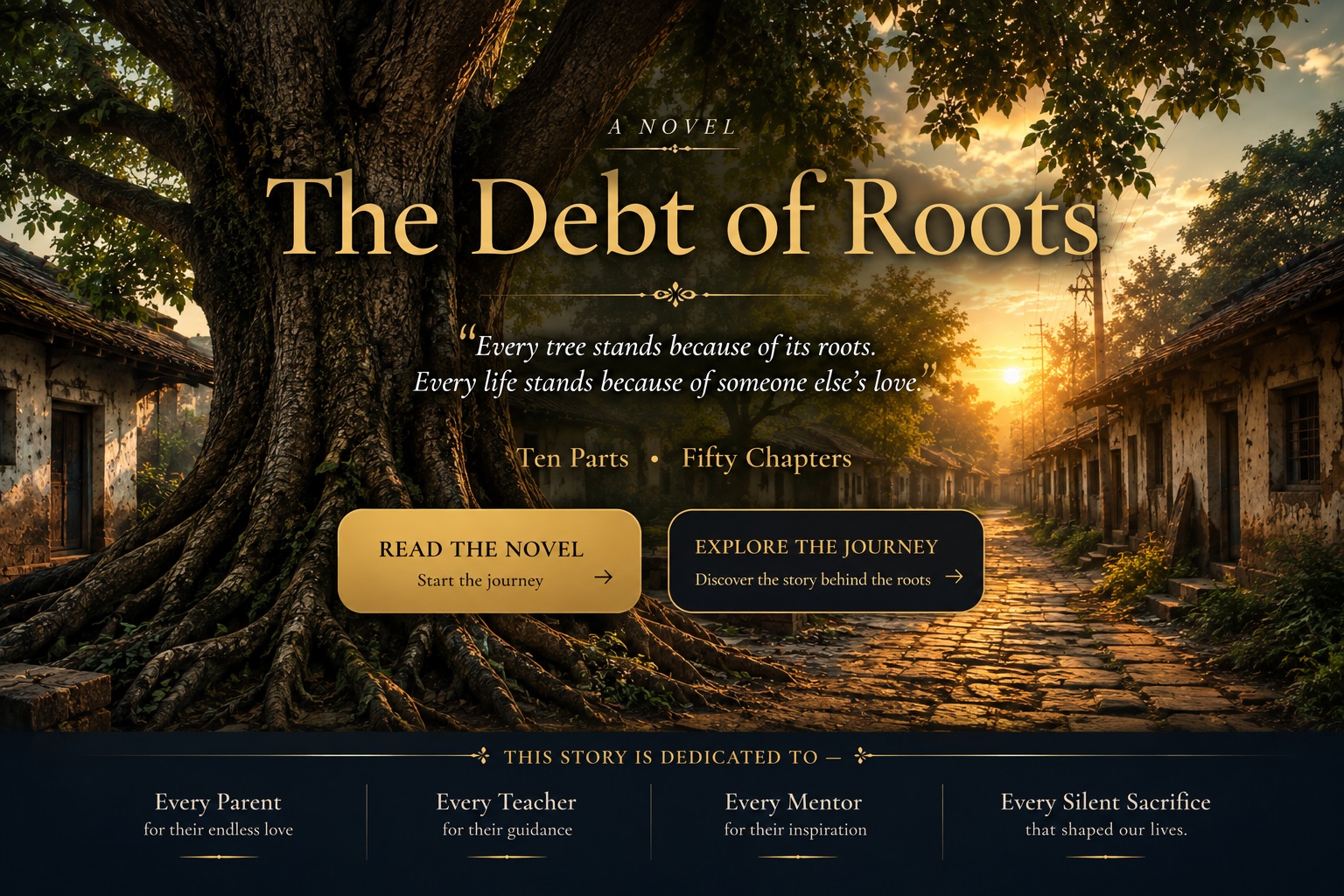
The Light of Waiting
As the first light of dawn broke over the eastern sky, Anantababu began walking down the village's dirt path. An old cloth bag in his hand, the weight of time on his shoulders. Everyone in the village knew him simply as "Mastermoshai" — the schoolmaster.
Age had caught up with him. His hair had turned white, his steps had slowed, but his habits had not changed. Every morning he watered the small garden in front of the house, then stood in the courtyard, gazing for a while at the dirt road in the distance.
That gaze, too, had a reason.
Every day he thought — perhaps today he will come.
From inside the house, his wife Mira Devi called out,
— "Listen, the tea is getting cold."
Anantababu smiled.
— "Coming."
But his eyes were still fixed on the road.
Mira Devi knew whom he was searching for.
Like every other day, today too, no one came.
Sitting down for tea, Mira Devi said,
— "Did you speak to him last night?"
Anantababu nodded.
— "He was very busy. Said he'd call later."
Mira Devi said nothing more. She knew that "later" often stretched into months.
This house had once been so full of life! Their son's morning scampering, the rush to get to school, stacks of books on the study table, the anxious nights before exams, warm rice from his mother's hands, stories from his father...
Today everything remained, only the sounds were gone. The books stood arranged in the cupboard. The toys lay covered in dust. The certificates hung on the wall as if silently asking—
"The one for whom we felt such pride — where is he today?"
Anantababu had never wanted anything for himself. Instead of buying a new pair of shoes, he bought his son books. He walked to school soaked in the rain rather than stop paying for his son's tutoring. He used the same umbrella year after year.
Once, at the village fair, his son wanted a toy car. That day, he spent the money set aside for his own new shirt to buy it for him.
That night, Mira Devi had said,
— "You really needed that new shirt."
Anantababu had smiled and said,
— "No one becomes a good person by wearing my shirt. But that smile on his face might one day carry him very far."
And that is exactly what happened. The boy grew up. Best in his studies among everyone. The pride of the village. The pride of the town. One of the country's most brilliant students.
The day he left, the whole village wept. Anantababu had only said—
"Wherever you are, remain a human being. Before becoming great, become a good person. It is not the height of success but love for other people that truly makes someone great."
The son had hugged his father and said,
— "I'll come back very soon."
No one knew that day — that some waiting never ends.
The afternoon light slowly faded. Anantababu came and sat in that same chair again. He kept looking toward the road.
A car approached from a distance. His heart suddenly began pounding. The car passed by without stopping in front of the house.
He smiled faintly and told himself,
— "Maybe tomorrow."
In the distance, the sound of the evening call to prayer drifted in. The leaves of the tulsi plant in the courtyard stirred. And the first star in the sky remained a silent witness — a father's waiting never ends.
The Seed of a Dream
The morning fog had not yet fully lifted. As the bell rang at the village's small primary school, a group of children came running in. Among them, the first to arrive was a ten-year-old boy.
His name was Arun.
An old school bag in his hand. Its zipper had torn, and his mother had stitched it back with needle and thread. A small tear on his shirt collar, but his eyes were full of dreams.
As soon as he entered the classroom, he went and sat on the front bench. Anantababu was writing on the blackboard at the time—
"Knowledge is a person's greatest wealth."
He turned around and smiled.
— "Arun, first again today?"
The boy lowered his head and said,
— "Father says, if you can rise before the sun, your dreams too will one day come true before everyone else's."
The classroom filled with laughter. But tears glistened in Anantababu's eyes. He knew this boy had come not merely to study, but to build a life.
After school let out, Arun was walking home with his father. An old beggar sat by the roadside. Arun stopped. He opened his own tiffin box and placed half his bread into the old man's hands.
Anantababu said nothing. Back home, he simply embraced his son.
— "Today you taught me a great lesson."
Arun asked, surprised,
— "What did I do?"
— "One who thinks of others even amid his own hunger is never truly poor."
In the evening, Arun was studying by the light of a kerosene lamp. Suddenly the power went out. Mira Devi lit a candle.
The boy said,
— "Mother, one day I will do something so that no child has to study in the dark."
His mother smiled and said,
— "Just become a good person. Greatness will come on its own."
That night, dinner was very simple — lentils, fried potatoes, and hot rice. Arun asked,
— "Father, are we poor?"
Anantababu was silent for a moment, then said,
— "One who has no money is not always poor."
— "Then who is poor?"
— "One who has no conscience, no love, no honesty — that is the poorest person of all."
Arun stared quietly at his father's face. Those words seemed to write themselves somewhere deep in his young heart.
A few months later, the results of the district merit exam were announced. The headmaster himself came to the house with the news.
— "Mastermoshai, your son has stood first in the entire district!"
In an instant, the whole village filled with joy. Someone brought sweets, someone brought flowers. Old Haren Kaku of the village said,
— "This boy will become someone great one day. He will bring shine to our village's name."
Anantababu smiled gently and said,
— "I only wish that he also brightens people's hearts."
It was late at night. Everyone was asleep. But Anantababu could not sleep. Quietly, he opened a notebook and did the sums. Admission fees... books... hostel... travel... as the numbers grew, so did the lines on his forehead.
Mira Devi came and sat beside him.
— "Why are you thinking so much?"
Anantababu let out a deep sigh.
— "The dream is growing bigger."
Mira Devi took off the gold bangles from her wrist, placed them in his hand, and said,
— "These aren't meant just to stay on my wrist. If they're needed to build his future, sell them today."
Anantababu gazed at his wife. He could not say a word. He only said to himself, silently—
"A mother loses her own ornaments so that her child's future may be adorned."
That very night, standing beneath the mango tree in the courtyard, Anantababu looked up at the sky. Countless stars were shining. He prayed silently—
"O Creator, make my son great — but not so great that one day he can no longer see his own roots."
The Morning of Farewell
It was the tail end of the monsoon. After rain through the night, the morning sky seemed even clearer. Dewdrops resting on the leaves of the mango tree in the courtyard shimmered like pearls in the morning light.
There was a strange silence in Anantababu's house today. No one spoke loudly.
Mira Devi had been busy in the kitchen since dawn — her son's favorite foods: hot rice, potatoes with poppy seeds, lentils, and payesh. Again and again she wiped her eyes with the end of her sari, as if it were only the smoke making them water.
But it wasn't smoke... it was the tears of farewell gathering inside a mother's chest.
Arun, wearing new clothes, came and stood before his father. A small bag in his hand — the first companion of life's new journey.
Anantababu took the bag and looked inside. Books, some clothes, and an old diary. On the diary's first page, he wrote in his own hand—
"Knowledge will make you great, but humility will give you a place in people's hearts."
Arun read his father's words and smiled faintly.
— "Father, I will keep this my whole life."
Many people had gathered at the village bus stand that day. The headmaster, neighbors, friends — everyone. Everyone was saying—
"This boy of our village will become someone great one day."
Haren Kaku placed a hand on Arun's head and said,
— "Son, earn plenty of money. But never lose people's blessings."
Arun touched his feet in respect. The sound of the approaching bus was heard. Mira Devi's chest suddenly trembled. She held her son tightly.
— "Eat properly. If you fall ill, don't hide it — tell someone."
Arun held his mother's hand and said,
— "I'll be back again in just a few months."
Mira Devi only nodded. Mothers know... that sometimes "a few months" turns into many years.
Anantababu placed a hand on his son's shoulder. There was firmness in his voice, yet a strange tenderness in his eyes.
— "Arun, remember..."
The son looked at his father.
— "There are many roads to becoming great in life. But there is only one road to becoming a good person — truth, hard work, and gratitude."
He paused a moment, then said again,
"Wherever you are, never forget your roots. The tree that forgets its roots is the first to fall in a storm."
Arun touched his father's feet in reverence. His eyes, too, had grown moist.
The bus slowly began to move. Sitting by the window, Arun kept waving. Anantababu and Mira Devi waved back.
As the bus grew more distant... the waving grew smaller and smaller... until at last only a line of dust remained. Then... even that faded away.
On the way back, both of them were silent. Entering the house, Mira Devi's eyes fell on Arun's study table. A pencil lay there. A notebook lay open. On the last page was written—
"My parents' dream is my dream."
Mira Devi pressed the notebook to her chest and wept. Anantababu stood by the window. He did not cry. He only looked up at the sky and said very softly—
"O Creator, let him not succeed only for himself. Let his success bring smiles to other people's faces."
In that moment, no one knew — this farewell was not only for studies... it was the beginning of a long, long wait.
Echoes of an Empty Room
After Arun left for the city, the first few days seemed as though they would never pass for Anantababu and Mira Devi.
At dawn, Mira Devi would make tea for three out of habit. Then, cup in hand, she would freeze. No one took the third cup anymore. Silently, that tea would go cold.
Every day, returning from school, Anantababu would open the door to Arun's room. The room remained exactly as it was. A pen on the study table. Books in the cupboard. A drawing of the sun on the wall, made in childhood.
It felt as though the door might open any moment and Arun would come running in, saying—
— "Father, I answered every question on today's exam!"
But the room gave no answer. Only the window curtain swayed in the breeze.
Every evening, Anantababu would stand in front of the village's little post office. In those days, a letter was the greatest thing to wait for. When the postman arrived on his bicycle, he would ask with a gentle smile—
— "Has anything come for me?"
The postman would shake his head, his face full of regret.
— "Not today either, Mastermoshai."
Still, Anantababu never lost hope. He believed — the son who had made a promise at parting would surely write.
One afternoon, the postman suddenly called out from a distance—
— "Mastermoshai... your letter has come!"
Anantababu's heart leapt. With trembling hands, he took the envelope. Mira Devi came and stood beside him. Arun's handwriting was on the envelope. Tears of joy filled both their eyes.
The letter read—
"Dear Baba and Ma, everything here is new. The pressure of studies is heavy. Sometimes it hurts so much. Then I remember home so deeply — Mother's cooking... Father's stories... the mango tree in the courtyard... the evening lamp... everything seems to float before my eyes. Please stay well. I am studying with my whole heart. One day I will bring light to your faces. — Your Arun."
As she read, Mira Devi's eyes grew wet. Anantababu pressed the letter to his chest and said—
— "You see, he hasn't forgotten us."
That very night, Mira Devi began knitting a wool sweater for Arun.
Anantababu smiled and said—
— "Now? Winter is still far off."
— "A mother's love has no season."
The days rolled on. Weeks turned into months. The letters grew fewer. Small messages took their place.
"I'm fine." "Exams are on." "Very busy."
In time, long silences settled in even between those messages. Anantababu would reassure himself—
— "His studies must have gotten heavier."
Mira Devi tried to believe it too. But a mother's heart is never fully deceived.
One night, Mira Devi said—
— "Listen... has our boy become very lonely?"
Anantababu was quiet for a moment. Then he said slowly—
— "Perhaps he's struggling against a new world."
Mira Devi sighed.
— "I only wish the new world doesn't erase his old one."
Anantababu gave no answer. Outside the window, the full moon had risen. Its light fell into Arun's empty room. The room seemed to wait in silence... the way a mother waits, the way a father waits, and the way a house waits — for the one it loves most.
"A house is not built of brick, wood, and cement alone. It is people's footsteps, laughter, tears, and love that turn a house into a home. And when that person goes far away, even the home learns to wait in silence."
The Beginning of Distance
City life felt like an entirely new world to Arun. Tall buildings, busy streets, people rushing about all day — everything was completely different from the quiet of the village.
For the first few weeks, he called home every day. Whenever Mira Devi picked up, she would say,
— "Have you eaten, son?"
Arun would laugh and answer,
— "Ma, no one cooks like you."
Anantababu, sitting nearby, would say,
— "Study with your whole heart. And take care of your health too."
From the other end of the phone, Arun would say,
— "Don't worry about me at all."
These few minutes of conversation were the joy of their entire day.
At college, Arun quickly became everyone's favorite. Talent, hard work, and humility — these three qualities set him apart. His professors would say,
— "This boy has the ability to achieve something great."
His friends respected him too. But city life doesn't just teach you to dream — it also teaches you to change.
Arun's roommate at the hostel was Rahul. One day Rahul said,
— "Why do you call home so much?"
Arun asked, surprised,
— "My parents wait for it."
Rahul laughed and said,
— "Come on! To grow up, you have to cut down on all this emotion. If you keep thinking about home all the time, you won't be able to move forward."
Arun said nothing. But the words settled somewhere in his mind.
After that, the calls slowly grew fewer. Instead of every day, once every two days. Then once a week. Then... whenever time allowed.
Anantababu, however, never complained. He would tell Mira,
— "The boy is very busy. His studies must be under a lot of pressure."
Mira Devi would nod with a faint smile. But she knew — busyness never diminishes love; it only diminishes contact.
One day, it was Arun's birthday. Mira Devi cooked payesh from early morning, as she had done since his childhood. Anantababu brought back a small cake from the market.
Mira Devi smiled and said,
— "Why such a small cake?"
— "He isn't here... but still, I felt the joy of his birthday should stay in this house, even today."
No call came all evening. Nine at night. Ten. Eleven. Mira Devi kept glancing at the phone.
Suddenly, at half past eleven, the phone rang. Arun. As soon as she answered, he said quickly,
— "Sorry Ma, I was very busy all day. My friends threw me a surprise."
Mira Devi only said,
— "Take care of yourself, son."
She didn't say that a bowl of payesh had been waiting for him all day long.
After the call ended, Anantababu sat looking at the small cake on the table. The candle was never lit.
He said slowly,
— "Mira, I'll give the cake to the schoolchildren tomorrow."
Mira Devi said nothing. She quietly went to the kitchen and closed the lid on the pot of payesh.
That night, Anantababu opened his old diary. He wrote—
"Distance can never be measured in kilometers. Distance begins the day a person, under the excuse of being busy, can no longer find time for those who are dearest to them."
He closed the diary. Outside, a light rain was falling. In the sound of the rain, it seemed as if someone was whispering very softly—
"Love is never lost. Only the habit of expressing it is lost."
That very night, Arun's life climbed one more step up the ladder of success. And in the lives of Anantababu and Mira Devi... the time of waiting grew a little longer still.