The Inheritance of Responsibility
An autumn sky. White clouds drifted slowly by. Today the village school field wore a strange, festive air. Students, teachers, parents, former students — everyone had gathered. Today was the first official program of "The Roots Initiative."
The stage bore no dazzling decoration. Just a simple banner, a few books, some saplings, and many hopeful faces.
Before the program began, Arun stood at one corner of the field. His eyes fell on a small boy, taking an old storybook from his bag and placing it in the donation box.
Arun went closer and asked—
— "Why are you giving this book away?"
The boy smiled.
— "Sir, I've finished reading it. Now someone else can read it."
Arun stood silent for a moment. This small act of a child seemed to teach him a deeper lesson than all his grand plans combined.
Elders from the village had also been invited to the program. Among them was eighty-year-old Uncle Haripada. He rose to the stage and said—
"In our time there were few books, but the will to learn was great. Today there are more books, more opportunities. Only one thing must never diminish — the bond of one person to another."
The whole field fell silent.
Then Arun rose to speak. He folded the prepared speech and put it away in his pocket. Today he wanted to speak not from paper, but from the heart.
"One day I left this school carrying many dreams. Those dreams carried me far away. But going far, I understood — a person's greatest identity is not where they have reached, but what they leave behind when they return."
Looking out over the field, he continued—
"Today I want to make you a promise. For as long as I can, I will stand by this initiative. But I want someone from among you to take up this responsibility in the days to come."
From the front row, a teenage boy stood up. His name was Rahul.
— "Brother, if you go back to your work, will this initiative come to an end?"
Arun smiled.
— "No."
He lifted a sapling that had been placed on the ground.
"If this tree survives by my hands alone, it will be a fragile tree. But if all of you water it, one day it will become a mighty banyan."
Then he said slowly—
"A good initiative belongs to no single person. A good initiative succeeds only when it becomes everyone's responsibility."
At the end of the program, book collection began for the library. Someone gave a dictionary, someone a science book, someone a storybook.
An elderly woman brought a few old books her husband had carefully kept, and said—
— "Locked in a cupboard, these are only paper. Only on a reading table do they truly come alive."
Anantababu folded both hands and bowed to her in respect.
In the afternoon, once everyone had left, the school field grew empty. Only a few newly planted saplings swayed in the breeze.
Anantababu slowly went and stood beside one of the saplings. Arun came and stood next to him too.
— "Look, the shade of what we planted today — perhaps neither of us will ever sit beneath it."
Arun smiled faintly and said—
— "And still, we planted it."
Anantababu looked at his son with contented eyes and said—
"Understanding just this truth is the greatest lesson of being human."
That night, Arun opened his diary and wrote—
"Today I understood — inheritance does not mean only land, a house, or property. Inheritance is values, education, responsibility, and love — passed from one generation into the hands of the next. Only if I can enrich that inheritance further and hand it into the next generation's hands will my life be truly fulfilled."
He closed the diary and looked out the window. From the direction of the school, a faint light drifted in the distance. It struck him — today was not merely the beginning of an initiative. It was the beginning of an inheritance of responsibility.
"The greatest wealth of a person's life is not what they earn, but what they hand into the next generation's hands — that is their true inheritance. The strength of roots is fulfilled only when the love, education, and responsibility of one generation is reborn as a new forest in the life of the next."
One Letter, Many Answers
A few weeks had passed since "The Roots Initiative" began. The village library was now crowded with students every day. The small room had filled with the smell of new books. On the wall, written large—
"Knowledge shared does not shrink — it grows."
Arun spent some time there every day. Sometimes he taught science, sometimes he read stories aloud, sometimes he simply listened to the students' questions. He had come to understand — teaching does not mean only giving answers; teaching someone to ask good questions is education too.
One day the postman brought an envelope. There was no sender's name on it. It only read—
— "For Arun-da"
Arun opened the envelope. Inside was a short, handwritten letter.
Dear Arun-da,
You don't know me.
I'm a student from this very village.
I used to think that growing up simply meant earning a lot of money.
Hearing you speak, I understood — a person grows great not for themselves alone.
From now on, I will teach the younger children every week.
Perhaps this is my beginning.
— A grateful student
After reading the letter, Arun could not speak for a long while.
Anantababu came over and asked—
— "What did it say?"
Arun handed the letter to his father. Having read it all, Anantababu said calmly—
— "See that?"
— "What, Father?"
"A seed that falls into a person's heart, its sprouting cannot be seen. But one day, suddenly, it becomes a forest."
That afternoon, a curious scene unfolded at the library. A small boy sat holding an old pencil. Beside him, another boy held out his own new pencil.
— "Here, let's share it and write together."
Arun smiled faintly and said—
— "Why did you give it to him?"
The boy answered simply—
— "You told us, sharing doesn't make a thing smaller — it makes the heart bigger."
Arun's eyes welled up despite himself. He understood — the truest test of education lies not in books, but in behavior.
In the evening, a few village elders sat in the courtyard. The topic of discussion — the village's future.
One of them said—
— "Before, everyone did nothing but complain."
Another said—
— "Now, at least, everyone is thinking about what they themselves can do."
Anantababu had been listening quietly. He said slowly—
"A society where participation outweighs complaint is a society that slowly, surely, changes."
Everyone nodded in silence.
At night, Arun sat on the veranda. Countless stars filled the sky. He said to his father—
— "Father, I used to think changing the world required grand plans."
Anantababu laughed and answered—
— "No, my son."
He gestured toward the lamp in the courtyard.
"Look, this small lamp cannot light up the whole sky. But it can drive away the darkness around itself."
He paused a moment, then continued—
"A person's life is much the same. Not everyone can become the sun. But everyone can become a lamp."
Arun silently took hold of his father's hand. Perhaps these words were the greatest research of his life.
That very night, he wrote on a new page of his diary—
"Today I understood — the change of a society does not begin on some grand stage. It begins with one good word, one honest act, one dream born in a child's heart. If even a single life finds its way to light, that effort is never a failure."
He closed the diary. Looking out the window, he saw the library window still lit. Perhaps some student was reading. Perhaps some new dream was being born.
That night, Anantababu too wrote one final line in his own diary—
"I no longer worry about the future. Because I have seen that the roots are alive. And wherever roots remain alive, a forest is certain, one day, to be born."
He capped his pen and set it down on the table. On his face, a deep and peaceful smile.
"A single good deed never stands alone. It gives birth to another good deed, and then another still. This is how one person's conscience changes a family, one family changes a society, and one society builds a new future."
The Shade of Roots
A mild winter morning. As the door to the village school's new library opened, students began filing in one by one. Some searched for storybooks, some for science, and some sat poring over a map of the world. In one corner of the room, a new sentence had been written on the wall—
"Dream, learn, and return to spread the light."
Arun stood by the door, watching it all. It felt to him as though this small room was the birthplace of countless futures.
Just then, a little girl came up and said—
— "Uncle, may I ask you something?"
Arun knelt down to be level with her eyes.
— "Of course."
The girl said—
— "I want to become a scientist when I grow up. But will I forget our village?"
Arun smiled gently and answered—
"Wherever in the world you go, gain knowledge, discover something new. But if now and then you come back and teach even a single child, then your village will live on within you."
The girl smiled. It was as though she had found not an answer, but a path.
At midday, Anantababu came to the library. The children gathered around him.
— "Grandfather, will you tell us a story?"
Anantababu thought a moment and said—
— "Not a story — let me ask you a question instead?"
Everyone grew eager.
— "Tell me, which part of a tree is the strongest?"
One said—
— "The branches."
Another said—
— "The trunk."
Someone said—
— "The leaves."
Anantababu shook his head. Then, pointing a finger toward the ground, he said—
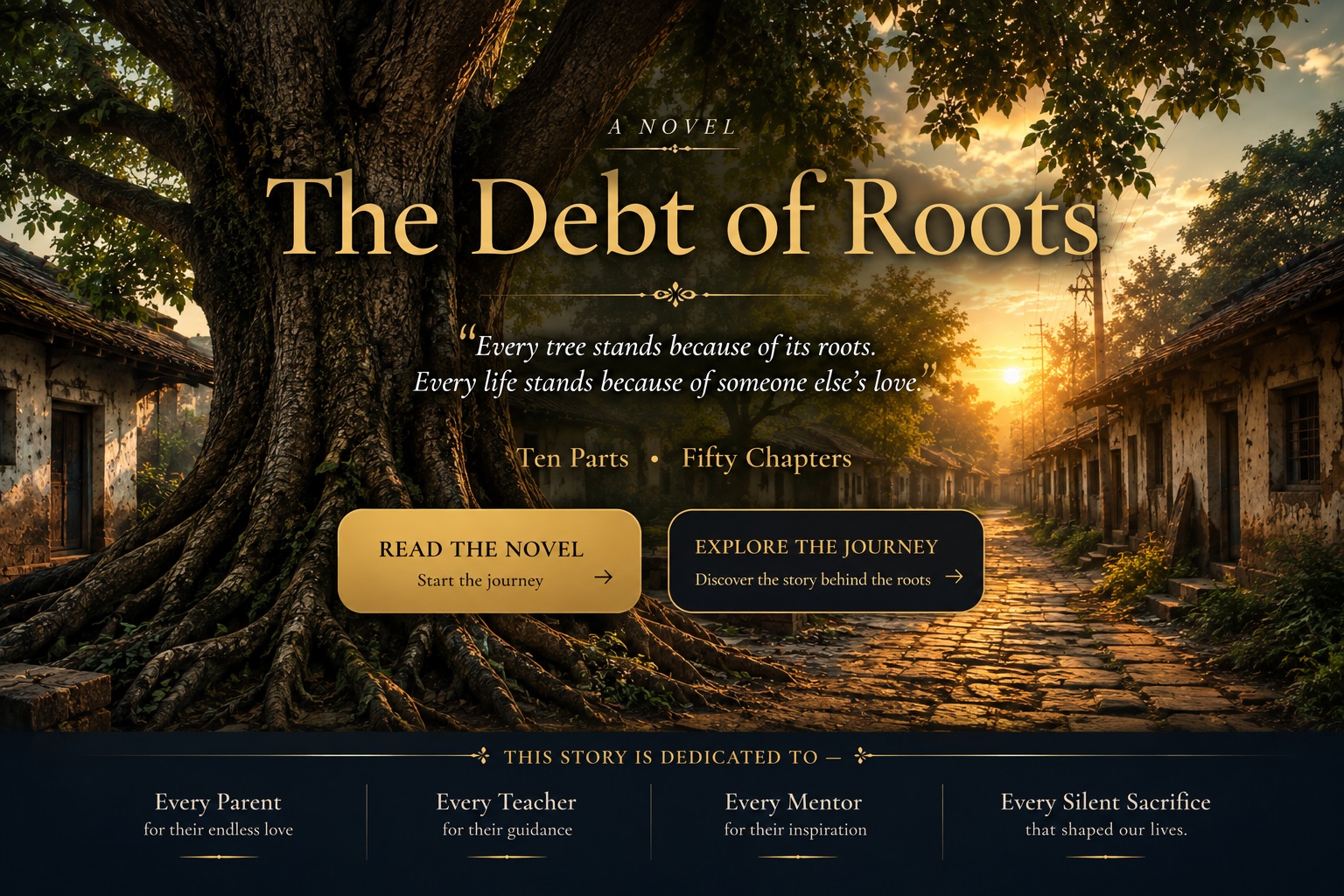
"No. The strongest part is the roots. Because they cannot be seen, and yet they hold the whole tree standing."
He paused a moment and looked at the children.
"A person's life has roots too — parents, teachers, values, and society. These cannot always be seen with the eye, but without them, a person can never truly grow great."
The room fell completely silent.
In the afternoon, Arun went to see the old library that had once been shut down. Now it had fresh paint, new shelves, new books. A few computers had even been set up in the corner.
An old librarian said, laughing—
— "After so many years, I'm hearing the sound of book pages turning again."
Arun looked around and said—
"Books don't only give knowledge — they give hope too."
In the evening, sitting in the courtyard, Arun said to his father—
— "Father, I'm going back to work."
Mira Devi fell silent. Anantababu said in a calm voice—
— "I know."
Arun paused, then said—
— "But this time it won't be like before. I'll come every year, without fail. Every month, I'll speak with the students online. And we'll all run the responsibility of 'The Roots Initiative' together."
A serene smile spread across Anantababu's face.
— "This is exactly what I want."
He said again—
"There's no need to sit beside your roots all the time. Just remember always where your strength comes from."
That night, Arun began an entirely new chapter of his diary. He wrote—
"Today I understood — life's true purpose is not where I live, but how I live. Wherever in the world I may be, a part of my time, a part of my knowledge, and a part of my heart will always belong to the soil where I first learned to walk."
Before capping his pen, he wrote one final line—
"The roots never held me down. The roots gave me the strength to fly — and, whenever I need, to return."
The night grew deep. The sky filled with stars. Anantababu stood on the veranda, looking up at the sky. Then slowly he said to Arun—
— "You know, after a person dies, people don't remember their house, their land, or their property for very long."
Arun listened in silence.
"But if a person can leave a light burning in someone else's life, that light itself becomes their truest memory."
Arun took hold of his father's hand tightly and said—
— "I will try, Father."
Anantababu placed a hand on his head and blessed him.
— "Don't just try... let your whole life walk that path."
"The debt of roots is never fully repaid. But through gratitude, responsibility, love, and service, a person learns to carry that debt with honor. And it is this very lesson that makes them not merely successful — but truly fulfilled."
Beyond the Roots, Within the Roots
The last afternoon of winter. Over the village sky, the sunlight was slowly softening. Arun's day of departure drew near. Inside the house, no one spoke of it aloud. But all three of them knew — these few days would end all too soon.
Mira Devi was packing clothes for Arun. Suddenly, from a corner of the wardrobe, a small wooden box came out.
The moment the box opened, Arun was astonished. Inside lay — his first pencil, his first prize medal, a broken toy car, and his first-grade report card.
Arun said, astonished—
— "Mother! You've kept all of this still?"
Mira Devi smiled faintly and said—
"Mothers never learn to throw things away."
She picked up an old pencil in her hand and said again—
"Perhaps you had forgotten. But I knew that one day, seeing these, you would remember your own beginning."
Arun could not speak any further.
In the evening, Anantababu sat in the courtyard. Arun came and sat beside him. After a long while, he said—
— "Father, may I say something?"
— "Go ahead."
— "Will I make the same mistake again?"
Anantababu remained silent for a while. Then he said slowly—
"Don't promise never to make a mistake."
Arun looked at him, surprised.
— "Then what?"
Anantababu smiled faintly and said—
"Promise instead — that when you realize your mistake, you will never feel too ashamed to return."
Hearing this, it struck Arun — perhaps this was the greatest lesson of life.
The next morning, the young members of "The Roots Initiative" sat down in a meeting with Arun.
Rahul said—
— "Brother, what if we run into trouble after you leave?"
Arun placed a notebook on the table and said—
— "This notebook is called the 'Ledger of Responsibility.'"
Everyone grew curious.
Arun said—
"In here will be written who does what work. But there is one condition."
— "What condition?"
"No one will write 'Leader' beside their own name. Everyone will write — 'Collaborator.'"
A girl student laughed and said—
— "Then who's the leader?"
Arun answered—
"The work. Good work itself is our leader."
A soft laughter spread through the room.
In the afternoon, a village elder came and said—
— "My boy, may I tell you something?"
— "Please, Uncle."
"Many people rise high. But not everyone remains one of our own."
He paused a moment, then continued—
"The day you returned, we did not see only a successful man. We saw a person who knows how to honor his own roots."
Arun silently touched his feet in respect.
At night, the three of them sat together in the courtyard, gazing at the sky.
Mira Devi said—
— "When will you come again?"
This time, Arun did not delay his answer.
— "Let's fix the date today itself."
He took out his phone and opened the calendar. He noted down the likely dates of his next holiday. Then he said—
"This time, the waiting won't be yours alone. It will be mine too."
Anantababu smiled faintly and said—
— "This time, I can believe your word."
Before sleeping, Arun was reading the last few pages of his father's diary. On one page was written—
"If my child returns only to me, I shall be happy. But if he returns also to his own conscience, then I shall find peace."
Arun slowly closed the diary. It struck him — he had not merely returned home. He had also found again the person within himself that he had lost.
Before dawn, Anantababu came and stood on the veranda. Far off in the eastern sky, the light of a new day was breaking. To himself, he said—
"The work of roots is not to tie a tree down.
It is to give it such strength that it can stand tall even in the midst of a storm."
Arun came silently and stood beside his father. No words passed between them. Both watched the same sunrise. In both their hearts, the same feeling — this time there would be a farewell, but not a parting.
"Life's greatest transformation happens only when a person learns to recognize their own responsibility anew, alongside changing their own fortune. For success carries a person to great heights, but gratitude gives them a place in the hearts of others."
The Invisible Debt
Five in the morning. The day of Arun's departure. A light mist hung over the courtyard. Birds called in the distance. Mira Devi had risen very early. Silently, in the kitchen, she was packing food for her son. Anantababu sat on the veranda. Today there was no newspaper in his hands. Only silence.
The car was still an hour from arriving. Arun came and sat beside his father. Both remained quiet for a long while.
Suddenly Anantababu said—
— "You know, there are certain debts in a person's life that money can never repay."
Arun listened attentively.
— "There is the debt to one's parents."
— "There is the debt to one's teachers."
— "There is the debt to society."
He paused a moment.
— "And there is the debt to those invisible people whom we never even come to know."
Arun said, astonished—
— "Invisible people?"
Anantababu took up a handful of dust from the courtyard ground.
— "Do you know who built this road?"
— "No."
— "Do you know how much labor of how many people went into building the school you studied in?"
— "No."
— "Treatment at the hospital, books in the library, bridges, electricity, drinking water — behind all of this, have you ever thought how much labor of unknown people, how many generations' contribution, lie hidden?"
Arun slowly shook his head.
"No one ever grows great alone. A person builds their own life standing upon the contributions of countless people, known and unknown. So gratitude toward society is not merely a feeling — it is also a duty."
Arun stayed silent for a long while. He recalled — the university laboratory, the scholarship, the library, teachers, classmates, colleagues. Could he have reached where he stood today without the cooperation of so many people?
"The answer was — no."
Toward noon, the members of "The Roots Initiative" came to bid him farewell.
Rahul said—
— "Brother, once you leave, we'll keep the work going."
Arun smiled.
— "Remember one thing."
Everyone looked at him.
"Never turn work that benefits people into your own personal credit. Turn it into everyone's shared responsibility."
Everyone nodded together.
Just then, the old post office clerk from the village stepped forward. Showing an old register, he said—
— "Your father had a habit."
Arun was surprised.
— "What habit?"
— "Whenever a scholarship paper or admission letter for a poor student arrived, he would deliver it door to door himself, so it would never be late."
Arun looked at his father in astonishment.
Anantababu said, embarrassed—
— "That's all old business now."
The old man laughed and said—
"Not old at all, sir. In the lives of those who stand established today, the worth of those small acts is very great."
The car pulled up in front of the courtyard. The moment of farewell drew near. Mira Devi hid her tears and handed over the bag.
Anantababu took a small piece of paper from his pocket.
— "Read this on the way."
Arun tucked the paper into his pocket and climbed into the car. The house, the courtyard, the mango tree — all slowly began drifting into the distance.
On the way, sitting by the car window, Arun opened the paper. Inside were only a few lines—
"People will know you by the height of your success.
But people will remember you by your conduct."
Wherever you are, ask yourself three questions—
• What did I learn today?
• Whom did I help today?
• Did my presence make even one life a little easier today?
— Father
Arun pressed the paper close to his chest. His eyes welled with tears.
That evening, arriving in the distant city, the first thing he did was join "The Roots Initiative's" online meeting.
One by one, faces appeared on the screen — Rahul, the little girl who wanted to be a scientist, the library's librarian, the headmaster, and finally, Anantababu and Mira Devi.
Anantababu said with a smile—
— "See? There is distance, but no separation."
Arun smiled too.
— "Yes, Father. From now on, however long the road may be, my bond with my roots will never be broken again."
Across the screen, the smiles of the three remained bound together as one.
"The greatest wealth of a person's life is not what they earn for themselves, but what they leave behind for others. Family gives us birth, teachers show us the way, society gives us the strength to move forward. And so the truest human being is the one who, with gratitude, gives back a part of their own success to the people around them."